


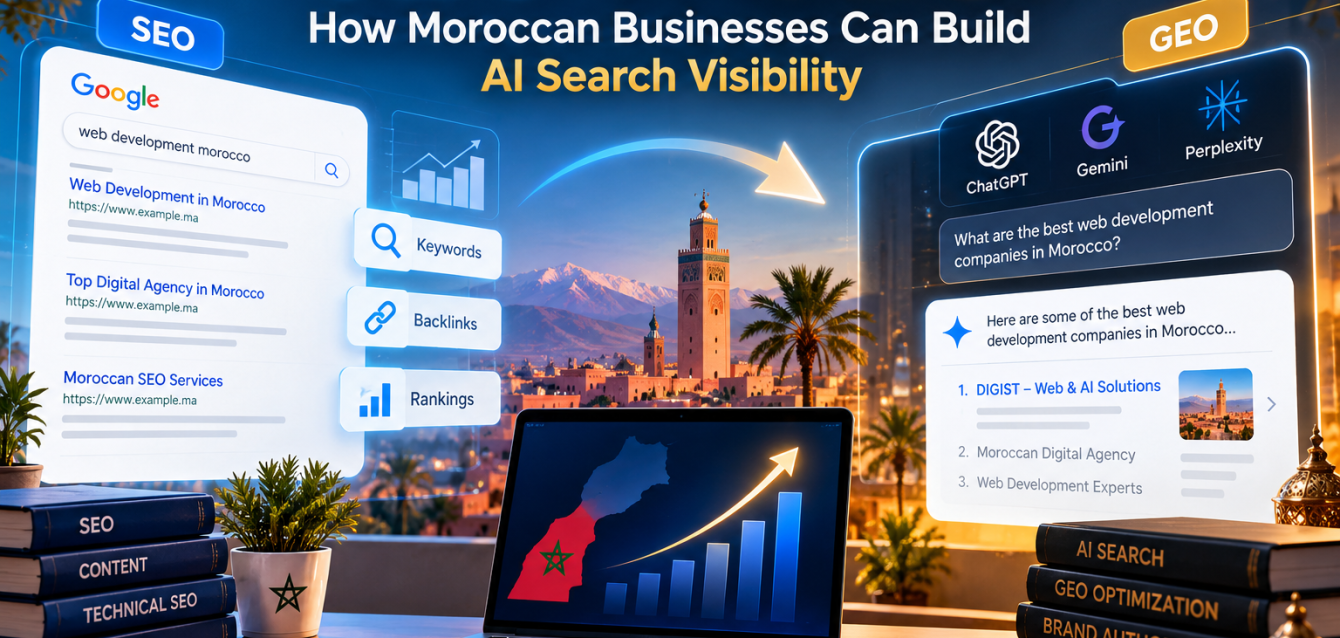
SEO improves how search engines discover, understand and present your website. GEO focuses on making your business information useful and credible in AI-generated answers. For a Moroccan business serving local and French customers, both start with accessible pages, a clear identity and evidence-backed content; neither can guarantee a ranking or citation.
Digist editorial draft. Sources checked on 24 October 2026.
What changes between SEO and GEO?
The practical difference is the output you are trying to influence. Traditional search often presents a list of links. An AI answer may summarise information from several sources and cite some of them. You still need a useful source page; a new acronym does not remove that requirement.
| Question | RÉFÉRENCEMENT | GEO |
|---|---|---|
| Main focus | Discovery and visibility in search results | Useful representation in generated answers |
| Content priority | Match the reader’s task with a strong page | Make facts, explanations and supporting evidence easy to identify |
| Measurement | Impressions, clicks, CTR and positions | Observed mentions, linked citations and resulting visits |
| Common mistake | Chasing keywords without solving the task | Claiming an AI citation can be guaranteed |
For Google’s AI features, the company states that established SEO practices remain relevant. Its AI features guidance does not describe a separate guaranteed route into AI answers.
Make the business identity unambiguous
State the business name, services, actual location and contact details plainly. Link to verified company profiles. Explain whether a customer in Morocco or France can order remotely, request a quotation or visit a physical location. Do not invent a French office because you serve French clients.
For Digist, the content should explain its print, web and digital service context consistently. A reader should understand which service is relevant before being asked to make contact. An About page and documented portefeuille de projets can provide complementary evidence.
Write answers that remain useful outside the page
Start with the answer
Open a service explanation with what is offered, who it serves and what the customer needs to provide. Follow with scope, process, examples and limits. A concise answer is easier to assess than an introduction that delays the point.
Show evidence and dates
Use original project details that you are authorised to publish. Explain your contribution without attributing a client’s whole business performance to a website. Cite primary documentation for technical claims. Date information that can change, such as product specifications, prices and delivery conditions.
Use the currencies your customers need
Where prices are approved for publication, label MAD or EUR and explain inclusions. If the amount depends on a brief, say “quotation required” and list the variables. An old converted price can be less useful than an honest scoped quotation. This article makes no claim about a standard Digist SEO or GEO monthly price.
Check technical access before adding more content
Review the actual HTTP response, indexing controls, canonical URLs and internal links. Check that meaningful content is available as text and works on mobile. Google’s AI optimization guide explains that special AI files or markup are not required for Google Search.
Keep structured data consistent with visible information. Organization, Service or other types should describe the real page and business. A schema label cannot substitute for an accurate service description, and adding every possible type is not a strategy.
Understand crawler choices
Search access and training permissions are different decisions. OpenAI distinguishes OAI-SearchBot from GPTBot in its crawler documentation. Review each provider’s current controls rather than assuming one robots.txt rule governs all AI products.
A business can evaluate search discovery separately from the use of its content for model training. Before changing crawler rules, document the purpose, the affected provider and the expected trade-off. Do not treat access alone as evidence that the business will be cited.
Measure citations without inventing a score
Use a small, repeatable prompt panel. Include a brand question, a service question and a local buying question. Record the exact prompt, engine, date, language and market context. Save the cited URLs and distinguish an unlinked mention from a linked citation.
If you cannot access an engine, mark the test “not performed.” A normal web search is not a substitute for observing an AI answer. Separate your own test sample from claims about every user’s experience.
For SEO reporting, compare comparable Search Console periods and keep brand queries separate from non-brand demand. A new citation, extra impressions and a qualified inquiry are different outcomes; report them separately.
A note on FAQs in 2026
FAQs can help readers find specific answers, but avoid promising a Google FAQ search enhancement. Google’s documentation updates state that FAQ rich results stopped appearing from May 7, 2026. This article’s FAQPage markup describes its visible questions; it is not a promise of a special result. See the official documentation updates.
Frequently asked questions
Is GEO a replacement for SEO?
No. For a business website, technical accessibility and useful search-focused content remain foundations. GEO adds attention to how business information can be represented and cited in generated answers.
Can an agency guarantee a ChatGPT citation?
No. A provider can improve content and technical foundations, but it does not control whether an external AI engine mentions or cites a business.
Is llms.txt required for Google AI visibility?
No. Google states that its search features do not require special AI files or markup. Maintaining llms.txt for other tools does not guarantee visibility.
How should a small Moroccan business measure progress?
Track brand and non-brand search performance, qualified inquiries and a documented sample of AI citation tests. Mark unavailable data as unavailable rather than reporting it as zero.
Give Digist a measurable visibility brief
Digist’s SEO, GEO and digital services can begin with your real pages, target markets and available data. Request an audit or scoped proposal covering technical priorities, content opportunities and a transparent measurement plan.
Sources
- Google — AI features and your website
- Google — AI optimization guide
- OpenAI — Crawler documentation
- Google — Documentation updates