



A business website that sits idle is a missed opportunity costing you customers every single day. In Morocco’s rapidly evolving digital landscape, your online presence either drives growth or fades into irrelevance. DIGIST has worked with businesses across the region navigating digital transformation, and we’ve seen firsthand what separates websites that convert from those that don’t. It’s not about flashy design or trendy features.
It’s about strategic alignment between your business goals, user experience, and the right marketing solutions that actually move the needle. This guide breaks down the core elements that make Moroccan business websites genuinely effective in 2026.
Why the best Moroccan websites win attention, trust, and action
The strongest business websites in Morocco do more than present information. They combine speed, local relevance, accessibility, and conversion-focused design so visitors can move from curiosity to contact with minimal friction. That matters in a market where mobile usage is dominant and where search, social, and direct navigation increasingly blend into the same customer journey.
- Mobile behavior is the default for many Moroccan users, so a site that feels clumsy on a phone quickly loses credibility. Global trend reports for 2026 consistently describe mobile-first as the baseline for modern web experience, not an optional upgrade.
- Search visibility now depends on usefulness, not just keywords. Modern search systems and AI-driven discovery tools pay attention to page performance, clarity, and whether users can actually complete a task once they arrive.
- Trust signals matter more than decoration. Clear contact details, multilingual support, secure payments, and visible privacy practices help turn traffic into business results, especially for Moroccan buyers making first-time online purchases.
- DIGIST’s role is to connect these pieces into one practical system, aligning design, development, and marketing so the website supports measurable growth instead of becoming a static brochure.
| What matters most | Why it matters in Morocco | What to do on your website |
|---|---|---|
| Mobile experience | Most users interact through smartphones and expect fast, thumb-friendly browsing. | Use responsive layouts, simple menus, readable text, and tap-friendly calls to action. |
| Local discoverability | Customers often search by city, service, and language. | Build bilingual or trilingual pages, optimize location pages, and strengthen local listings. |
| Trust and security | Visitors need reassurance before they submit a form or pay online. | Show SSL, privacy policy, secure checkout, and recognizable payment options. |
| Conversion focus | A website should generate quotes, calls, bookings, or purchases. | Place clear CTAs above the fold and remove unnecessary steps from forms and checkout. |
Key features of a truly effective business website in Morocco
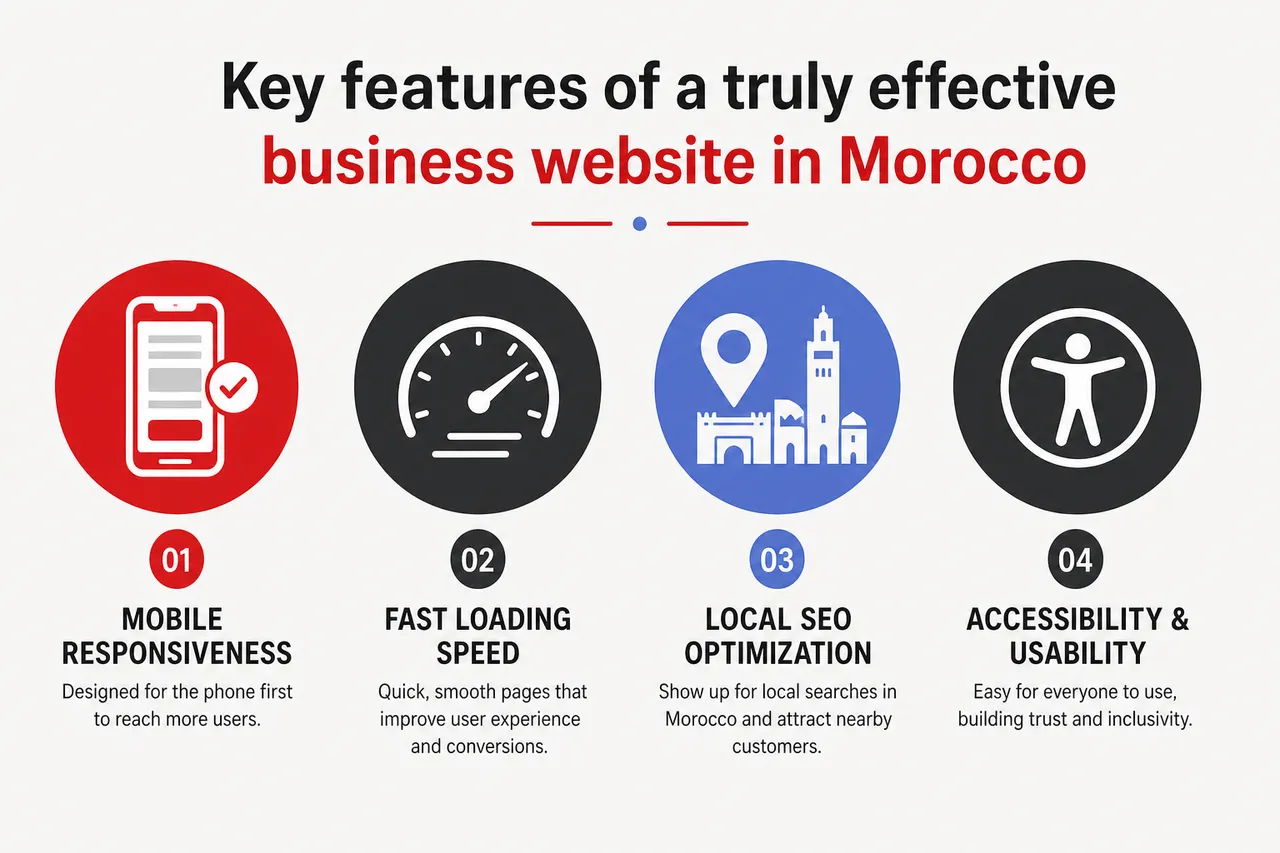
In 2026, simply having a website is not enough for Moroccan businesses. The digital landscape demands more: performance, local relevance, accessibility, and a seamless user experience are all non-negotiable. The most effective business websites in Morocco bring these elements together in ways that feel effortless for users and impactful for business growth.
Mobile responsiveness and fast loading
With mobile usage dominating web behavior in Morocco, a site that fails on small screens immediately loses reach. Trend research for 2026 also shows that speed is now treated as part of the design itself, because users and search systems both reward pages that load quickly and behave smoothly. DIGIST often approaches mobile optimization as a conversion issue, not only a technical one, because faster pages usually mean more calls, more inquiries, and fewer abandoned visits.
- Design for the phone first, then scale up to desktop. This keeps navigation cleaner, content shorter, and calls to action easier to find when someone is browsing quickly between tasks.
- Cut heavy assets and unnecessary scripts. Lightweight images, efficient code, and fewer plugins reduce load time and create a more reliable experience on variable mobile connections.
- Test real interactions such as tapping buttons, opening menus, and submitting forms. Many sites appear mobile-friendly but still frustrate users when actual actions are too small, slow, or crowded.
Local SEO optimization
When someone in Rabat or Agadir searches for your services, the goal is not just visibility but relevance. Effective Moroccan business websites are structured around local intent, language variation, and search patterns that reflect how people actually look for services in French, Arabic, and English. Local SEO becomes stronger when the site clearly explains what the business does, where it operates, and how a customer can take the next step.
- Build pages around local intent. A service page for Casablanca should speak differently from one for Tangier if customer needs, search phrasing, or delivery conditions vary by location.
- Keep business information consistent across the website and local listings. Search platforms use this consistency as a trust signal, and customers use it to decide whether to call or visit.
- Use structured content such as clear headings, FAQ sections, and schema-friendly page layouts. These help both traditional search and AI-assisted discovery systems understand the business faster.
AI-driven enhancements
AI tools are increasingly useful for Moroccan businesses that want to respond faster and work more efficiently. The most practical use cases are not futuristic experiments but everyday tasks such as answering common questions, guiding visitors to the right service, and helping sales teams prioritize leads. DIGIST can integrate these tools so they support the customer journey without making the site feel automated or impersonal.
- Chatbots work best when they solve narrow problems well. They should answer common questions, qualify leads, and route users to a human when the request becomes complex.
- Personalization should be subtle. Product recommendations, service suggestions, and contextual prompts can improve engagement when they feel helpful rather than intrusive.
- Analytics-assisted decisions matter. AI can help identify the pages where users drop off, which content converts best, and where new opportunities are emerging.
Culturally relevant and user-centric design
Moroccan users feel more comfortable when a website looks and behaves in a familiar way. That includes language flexibility, readable typography, intuitive navigation, and imagery that matches local expectations without feeling generic. A site built for Morocco should also feel inclusive, because accessibility and clarity make the experience better for everyone, not just for a narrow segment of users.
- Language switching should be frictionless. Visitors should not have to search for the right version of the site, especially if they arrive from search or social media.
- Visual hierarchy should feel obvious. People should immediately see what the business offers, why it matters, and how to act next.
- Accessibility should be part of design from day one. Good contrast, readable text, keyboard-friendly navigation, and descriptive alt text improve usability and strengthen the Generally quality of the site.
Secure payment and data protection
Trust is essential for any business that expects customers to submit information or pay online. Moroccan shoppers look for secure payment options, visible privacy practices, and signs that their data will be handled responsibly. A website that explains security clearly often performs better than one that assumes users will trust it automatically.
- Show security visibly. SSL certificates, privacy notices, and trustworthy payment badges reduce hesitation at critical moments in the journey.
- Make checkout simple. The easier it is to complete a payment on mobile, the more likely customers are to finish the transaction.
- Respect data rules and expectations. Clear consent language and responsible data handling help the business appear professional and reliable.
- Focus on mobile-first design to reach most Moroccan users where they are.
- Invest in local SEO so your business is visible to nearby customers.
- Leverage AI tools for smarter customer support and personalized experiences.
- Design with Moroccan user preferences in mind to build trust and engagement.
- Make security and data protection a top priority to gain customer confidence.
| Website element | Impact on performance | Most useful when… |
|---|---|---|
| Fast mobile pages | Reduces bounce rate and improves conversions. | Visitors are arriving from phones and making quick decisions. |
| Local landing pages | Improves relevance in city-based searches. | Your business serves multiple Moroccan markets or regions. |
| Chatbots and automation | Speeds up response time and lead capture. | Your team receives many repetitive inquiries. |
| Clear trust signals | Raises willingness to submit a form or payment. | You sell services, appointments, or products online. |
What most sites miss, and why it changes results in Morocco
Many websites look polished on the surface but still underperform because they ignore the parts of the journey that matter most to real users. In Morocco, the gap often appears in local relevance, accessibility, and the ability to turn attention into action. This is where a partner like DIGIST can make a measurable difference by connecting web design to business outcomes rather than treating it as a one-time build.
Accessibility is a growth issue, not a cosmetic one
Accessible websites are easier for everyone to use, including people browsing in bright sunlight, on old devices, or with limited patience. In 2026, accessibility is also increasingly tied to search quality and user trust, which means it supports both usability and visibility. Small improvements such as stronger contrast, better labels, and more readable layouts can produce outsized gains in engagement.
Conversion paths need to be shorter than most businesses expect
Many Moroccan business sites ask too much of visitors before offering value. A better website removes friction by putting the phone number, quote form, WhatsApp contact, or booking action exactly where users expect it. DIGIST typically designs these paths around the actual business goal, because the most effective websites are not the busiest ones, but the ones that help people act quickly.
Content must answer the questions people actually ask
Search intent matters as much as keyword placement. If a visitor wants pricing, delivery areas, turnaround times, or proof of experience, the site should answer those questions immediately instead of hiding them behind generic marketing text. This is especially important in Morocco, where multilingual visitors may scan quickly and leave if the content feels vague or overly promotional.
Leveraging digital transformation and AI for business growth
Digital transformation is rapidly reshaping the way Moroccan businesses operate and grow. Integrating AI-driven solutions and adopting modern digital tools helps companies become more agile, efficient, and competitive.
Integrating AI-driven tools
AI is no longer limited to large enterprises. Moroccan SMEs are increasingly using chatbots, dynamic pricing, and predictive analytics to simplify operations and improve customer service, and those tools work best when they are linked directly to the website experience. A website that collects leads, answers questions, and routes requests intelligently can reduce manual workload while creating a smoother path to conversion.
- Chatbots should support the sales funnel, not just answer FAQs. They can qualify leads, recommend services, and hand off complex cases to a human team when needed.
- Predictive insights help prioritization. When a business understands which pages, services, or products generate the most interest, it can invest more intelligently in growth.
- AI works best when paired with good data. Clean content, structured forms, and clear workflows make the output more useful and more reliable.
Streamlining operations with digital solutions
Cloud services, modern CRMs, and workflow automation can be game-changing for Moroccan businesses that want fewer manual tasks and faster response times. These tools are most effective when they are connected to the website, because that is where customer demand first becomes measurable business activity. DIGIST often treats the website as the front end of a wider digital system, not as an isolated asset.
- CRM integration helps sales follow-up. Leads from forms, calls, or chat can move into one pipeline instead of being scattered across inboxes and notebooks.
- Automation protects speed at scale. Confirmation emails, appointment reminders, and lead routing reduce delays and improve consistency.
- Cloud tools support growth. They let teams update content, manage inventory, and coordinate customer service without depending on a single device or location.
- AI solutions are more accessible than ever, thanks to lower costs and growing expertise in Morocco.
- Digital transformation is a strategic necessity for businesses that want to stay competitive in 2026.
- Cloud and automation free up resources, letting your business move faster and compete more effectively.
| Digital capability | Business value | Website impact |
|---|---|---|
| AI chatbot | Faster customer response | More leads captured outside business hours |
| CRM integration | Better follow-up discipline | More organized sales pipeline |
| Workflow automation | Less repetitive work | Faster confirmations and service replies |
| Cloud infrastructure | Greater flexibility and resilience | Easier content updates and operational scale |
Case studies: successful Moroccan business websites
The best way to understand what works is to look at Moroccan businesses that have made digital transformation work in practice. The common pattern is not size but clarity: each successful site knows its audience, keeps the user journey simple, and connects the website to a real operational goal.
DIGIST: empowering SMEs with custom web solutions
DIGIST has helped Moroccan SMEs bring their visions to life online through tailored websites, multilingual layouts, secure portals, and AI-enabled workflows. One Casablanca logistics provider, for example, used a bilingual mobile-optimized website with a chatbot and a secure customer portal to increase online quote requests and reduce repetitive inquiries. That kind of result shows how a website can become a productive sales and service tool, not just a digital brochure.
Retail success: culturally relevant e-commerce platforms
A Moroccan fashion retailer improved online sales after prioritizing mobile design, local payment gateways, culturally relevant visuals, and AI-powered recommendations. The lesson is straightforward: customers respond when a site feels easy to use, locally familiar, and genuinely helpful at the moment of purchase. DIGIST’s approach in these projects is to make the website fit the buying behavior of the market instead of forcing visitors to adapt to a generic template.
- Local case studies provide practical lessons that are easier to apply than abstract web trends.
- SMEs can compete effectively when the website is built around user needs and business outcomes.
| Case study | What changed | Business outcome |
|---|---|---|
| DIGIST logistics client | Bilingual site, chatbot, secure portal | More quote requests and fewer support interruptions |
| Moroccan fashion retailer | Mobile-first design, local payments, recommendations | Higher online sales and stronger customer loyalty |
Actionable steps and best practices for Moroccan businesses in 2026
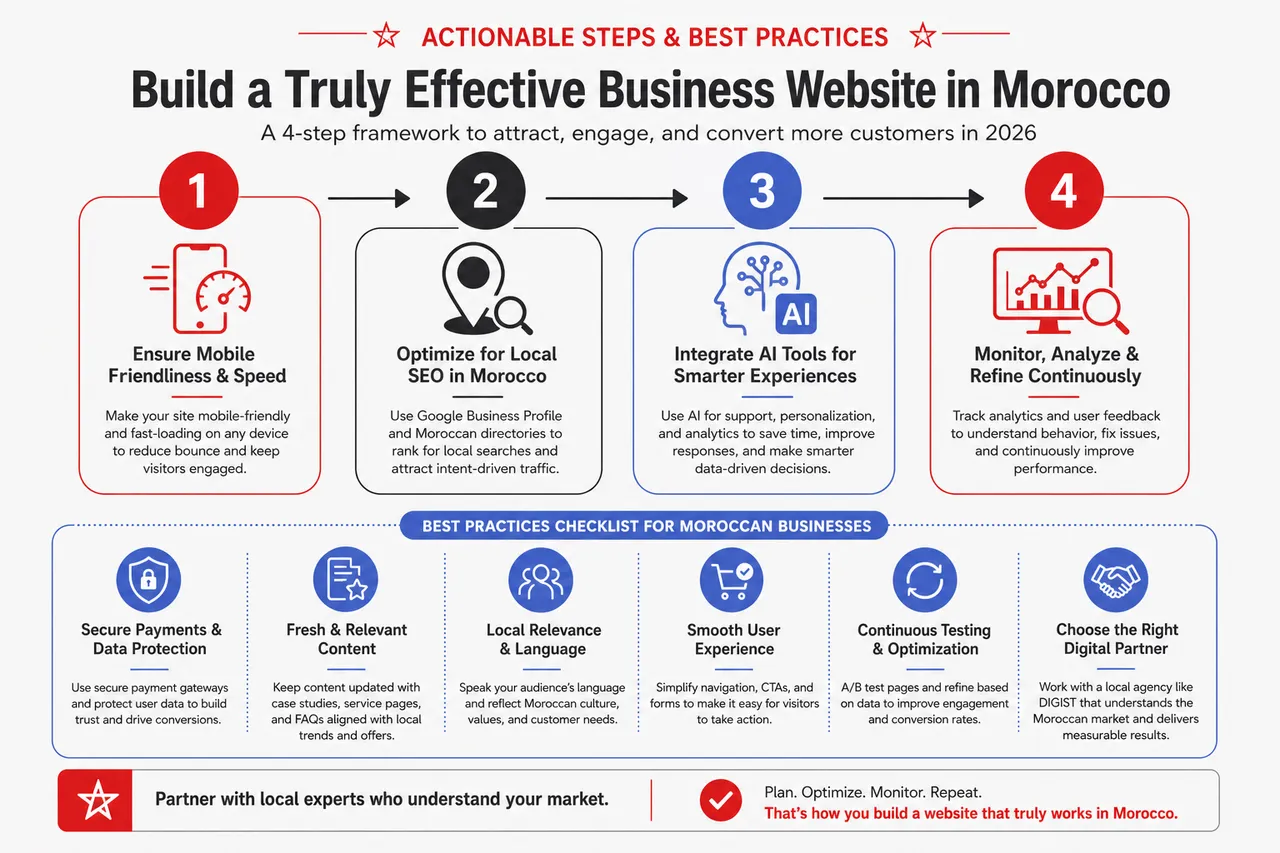
Creating an effective business website in Morocco takes planning and continuous improvement. The strongest sites are monitored, updated, and refined based on user behavior, not just launched and left alone.
Website effectiveness checklist for Morocco
- Make sure your site is mobile-friendly and loads quickly on any device. This is the foundation of modern usability, especially for visitors who are comparing options on their phones and may leave after only a few seconds if the page feels slow or awkward.
- Optimize for local SEO, including Google Business profiles and Moroccan directories. This helps your website appear when people search by service and location, which is one of the most valuable forms of intent-driven traffic.
- Use AI tools for support, personalization, and analytics. These tools save time, improve response quality, and reveal patterns that can guide smarter marketing decisions.
- Provide secure payment gateways and strong data protection. If visitors do not trust your site, they will not convert, no matter how attractive the design looks.
- Keep your content fresh and aligned with local trends and offers. Updated case studies, service pages, and FAQ content signal that the business is active and reliable.
- Monitor analytics and user feedback to guide continuous improvements. Data shows where visitors click, hesitate, and leave, which makes it easier to prioritize the next round of changes.
Choosing the right digital partner
Working with a local agency like DIGIST, which understands Moroccan digital trends and consumer behavior, can make all the difference. A knowledgeable partner helps you navigate regulations, cultural expectations, and emerging trends, ensuring your website is not just functional but truly effective. That matters most when the website must support both marketing and operations at the same time.
- Look for strategy, not only design skills. The partner should understand conversion, content, SEO, and performance as one connected system.
- Ask how they measure results. A serious partner should be able to explain how traffic, leads, calls, and sales will be tracked.
- Choose someone who understands Morocco specifically. Local context shapes language, trust, payment preferences, and search behavior, all of which affect performance.
- Use this checklist to regularly review and improve your website.
- Continuous updates and feedback loops keep your site effective as trends shift.
- Tailoring your approach for the Moroccan market delivers better results than one-size-fits-all solutions.
The impact of user experience and digital trends in Morocco
User expectations in Morocco are growing more sophisticated each year. Technology adoption and cultural shifts are changing how people interact with business websites, and the websites that keep pace tend to be the ones that feel simple, fast, and relevant.
Moroccan consumer behaviors in 2026
Convenience, speed, and local relevance matter most to Moroccan consumers. Mobile payments are increasingly normal among younger buyers, and instant support is now a standard expectation for many service categories. Businesses that offer quick navigation, visible contact options, and clear answers usually see stronger retention because they reduce effort at the exact moment users are ready to decide.
Adapting to emerging digital trends
Staying ahead means paying attention to what is actually changing in user behavior. Voice search, short-form video, WhatsApp-based commerce, and AI-assisted browsing are all becoming more visible in customer journeys, and websites that support these habits feel more current and easier to use. DIGIST helps businesses adapt these tools in a way that fits the brand and the audience instead of chasing trends for their own sake.
- Voice-friendly content helps users who search naturally with questions rather than exact keywords.
- Short video or visual demos can reduce uncertainty for products and services that need explanation.
- WhatsApp contact paths can shorten the distance between interest and action for Moroccan users who prefer fast conversational interaction.
- Designing for Moroccan users starts with understanding their habits, preferences, and expectations.
- Keeping up with new digital trends is essential for staying relevant and competitive in 2026 and beyond.
Morocco’s digital market is moving fast, but businesses that focus on mobile readiness, local SEO, AI-powered enhancements, accessibility, and culturally tuned design have a real advantage. By adopting these best practices and learning from local success stories, your business website can become a true growth engine. If you are ready to take the next step, partnering with a digital team like DIGIST can help turn those priorities into a site that supports growth, trust, and long-term performance.