



Web design isn’t dying in the AI era, it’s splitting into two paths. One leads to commoditized templates and race-to-the-bottom pricing. The other? Building a profitable business that solves real problems through strategy, not just pixels. If you’re serious about the latter, you need more than design chops. You need positioning, systems, and the ability to deliver measurable business growth.
DIGIST has helped businesses navigate digital transformation by pairing smart software development with marketing that actually moves the needle. This guide walks you through finding your niche, pricing for profit, landing clients, and scaling without burning out.
Laying the Foundation: Planning and Positioning Your Web Design Business
The web design world in 2026 is shaped by a powerful mix of AI-driven automation and strategic thinking. Agencies that thrive do not just deliver attractive websites; they become true partners who help clients solve business challenges, hit revenue targets, and stand out in increasingly AI-saturated markets. To get there, you will want to focus on three fundamentals: picking the right niche, building a strong identity, and weaving AI into your business plan from day one.
Identifying Profitable Niches in 2026
Finding your sweet spot starts with spotting industries hungry for digital change and personalization. In 2026, sectors like healthcare, legal, e commerce, education, and professional services are doubling down on web experiences powered by AI, analytics, and automation. Global digital transformation spending is projected to surpass 3.4 trillion dollars by 2026, and small to mid sized service businesses are increasingly redirecting a portion of that budget into web, CX, and automation projects, which creates fertile ground for specialized agencies.
- Healthcare: Clinics and telehealth providers are investing in compliant, mobile first sites with AI enabled patient portals that handle triage, appointment routing, and education. For a web design agency, this means recurring work around secure UX flows, integrations with electronic health record systems, and ongoing optimization for accessibility and trust. DIGIST style solutions that combine secure hosting, analytics, and workflow automation can become the backbone of these projects.
- Legal: Law firms are under pressure to modernize client intake, document automation, and case tracking, yet many still rely on outdated brochure sites. Agencies that can deliver AI assisted intake forms, secure client portals, and workflow dashboards can often charge premium retainers, especially if they position these features as a way to reduce admin time and increase billable hours.
- E commerce: AI powered recommendations, context aware offers, and geo located content are becoming table stakes for online retailers. In 2026, the global retail ecommerce market is expected to exceed 8.5 trillion dollars, and even small brands are seeking personalization engines, performance first design, and conversion centric UX. Agencies that bundle AI merchandising, A/B testing, and analytics management alongside design can participate in the value they help create, not just the initial build fee.
- Education & learning platforms: EdTech companies, training providers, and even smaller course creators are moving toward adaptive learning experiences. This opens opportunities for agencies that can integrate AI driven content recommendations, progress dashboards, and community features. With global e learning revenues growing at more than 14 percent compound annual growth, a tightly focused education niche can generate a steady stream of redesigns and feature expansions.
Some of the most successful agencies go even deeper, for example narrowing in on multi location dental clinics, SaaS landing pages, or niche ecommerce brands in segments like sustainable fashion or boutique fitness. This level of focus lets you craft truly custom solutions, build reusable components, and command higher fees because you can speak the client’s language and provide proven playbooks instead of generic advice.
Positioning Your Agency as a Strategic Partner
With so many template driven services and AI site builders in the market, You really should show clients that you deliver business outcomes, not just attractive layouts. Strong positioning means articulating how your work impacts revenue, lead quality, lifetime value, and brand trust, and backing that up with clear offers and processes.
- Lead with outcomes, not aesthetics. Instead of talking only about colors and components, describe how your websites increase conversion rates, shorten sales cycles, or improve customer retention. For example, DIGIST worked with a fitness brand and, after rolling out AI powered lead capture, progressive forms, and analytics driven landing page tests, the client saw a 40 percent surge in online signups. That kind of result oriented story speaks directly to business owners who are comparing you with low cost template options.
- Educate prospects on AI driven value. Many clients have heard about AI tools but do not understand how they translate into revenue or operational savings. Use simple, concrete explanations of features like AI powered personalization, accessibility checks, and workflow automation. Frame them as levers that improve metrics such as conversion rate, average order value, and support costs, and show how DIGIST style stacks make managing these levers easier over time.
- Productize discovery with workshops or audits. Offering structured strategy workshops, UX audits, or AI opportunity assessments as a paid first step helps you demonstrate expertise before a large engagement. These sessions can uncover quick wins, align stakeholders, and give you the information required to propose the right DIGIST powered solution. They also shift your role from vendor to trusted advisor from the very first interaction.
This shift in positioning reframes your agency as a long term partner that sits at the intersection of design, technology, and growth. As one DIGIST client, Destockage Original, put it: “A team that is always ready to listen and provide the right solutions. Absolutely recommended.” That is the kind of positioning that survives cost focused procurement and AI driven commoditization.
Building an AI Integrated Business Plan
For 2026 and beyond, your business plan should treat AI as core infrastructure rather than a side experiment. This includes how you operate internally, how you price and package services, and how you plan for growth and risk. Agencies that formalize their AI approach usually deliver projects faster, maintain higher margins, and create more predictable results for clients.
- Operations: Start by mapping your current processes from lead intake to post launch optimization and identify repetitive, rules based tasks. Prototyping, content drafts, QA checks, status reporting, and basic support can often be automated or AI assisted. DIGIST style custom automation can streamline proposals, onboarding, and reporting, while still keeping humans in charge of discovery, strategy, and final creative direction. The goal is a workflow where AI handles the groundwork and your team focuses on judgment, relationships, and high level problem solving.
- Revenue: Mix project based fees with recurring income streams so you are not starting from zero each month. Maintenance, high performance hosting, analytics subscriptions, CRO retainers, and AI training packages can all be wrapped into tiered service plans. Many agencies now aim for at least 40 to 60 percent of their revenue to come from recurring services, as this stabilizes cash flow and protects against project droughts. DIGIST’s combination of hosting, monitoring, and marketing automation is well suited to anchor these retainers.
- Growth: Use data from past projects, industry benchmarks, and your own pipeline analytics to set realistic, AI informed growth goals. For example, if your average project value is 15,000 dollars and your typical close rate is 25 percent, you can work backwards to estimate required opportunities per quarter. AI powered forecasting tools and CRM analytics can then help you track whether you are on pace, highlight bottlenecks in the sales process, and point to the channels that generate your best leads.
While some believe AI can replace all human input, agencies that consistently outperform their peers treat AI as leverage for strategy and creativity, not as a substitute. This combination of automation and consulting is difficult for generic tools to replicate and tends to generate both better outcomes for clients and healthier margins for the agency.
Essential Tools and AI Solutions for Modern Web Design Agencies
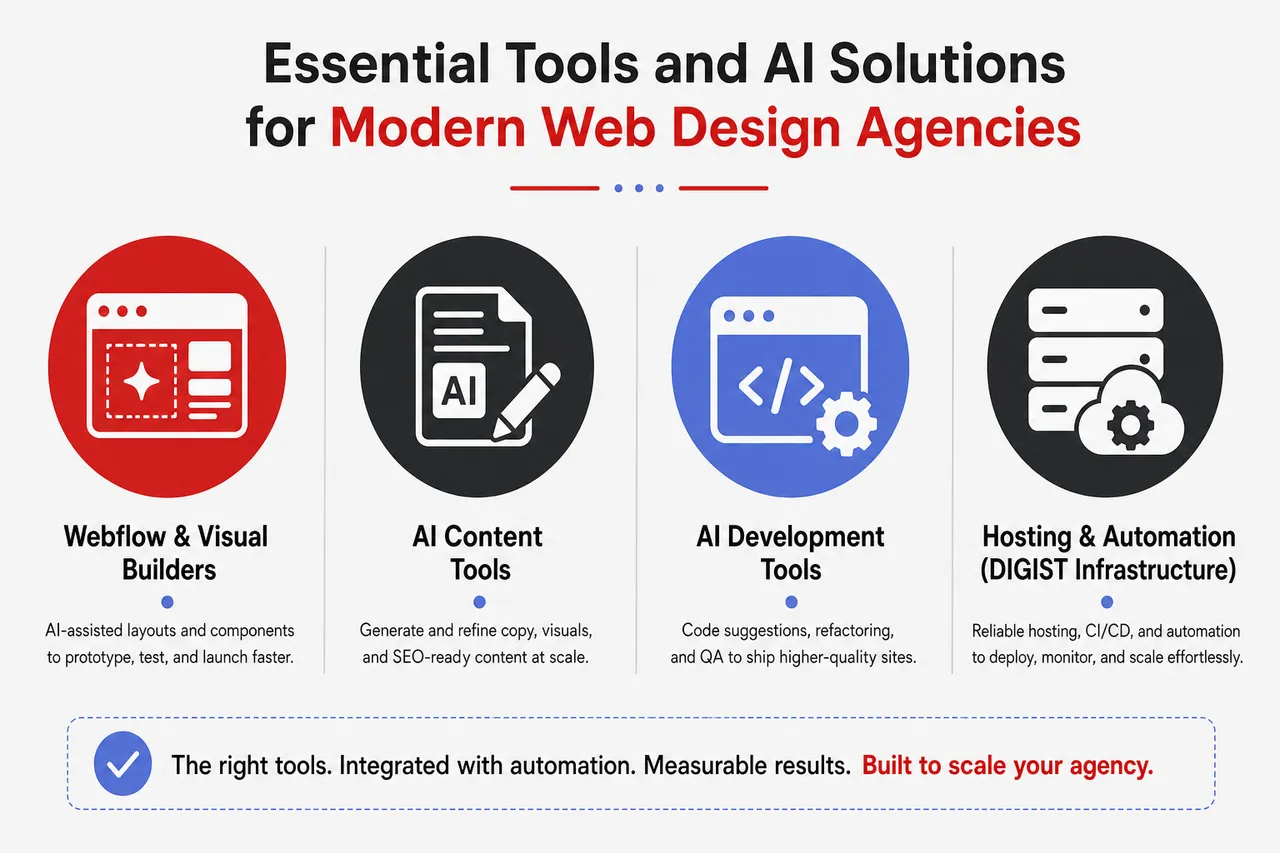
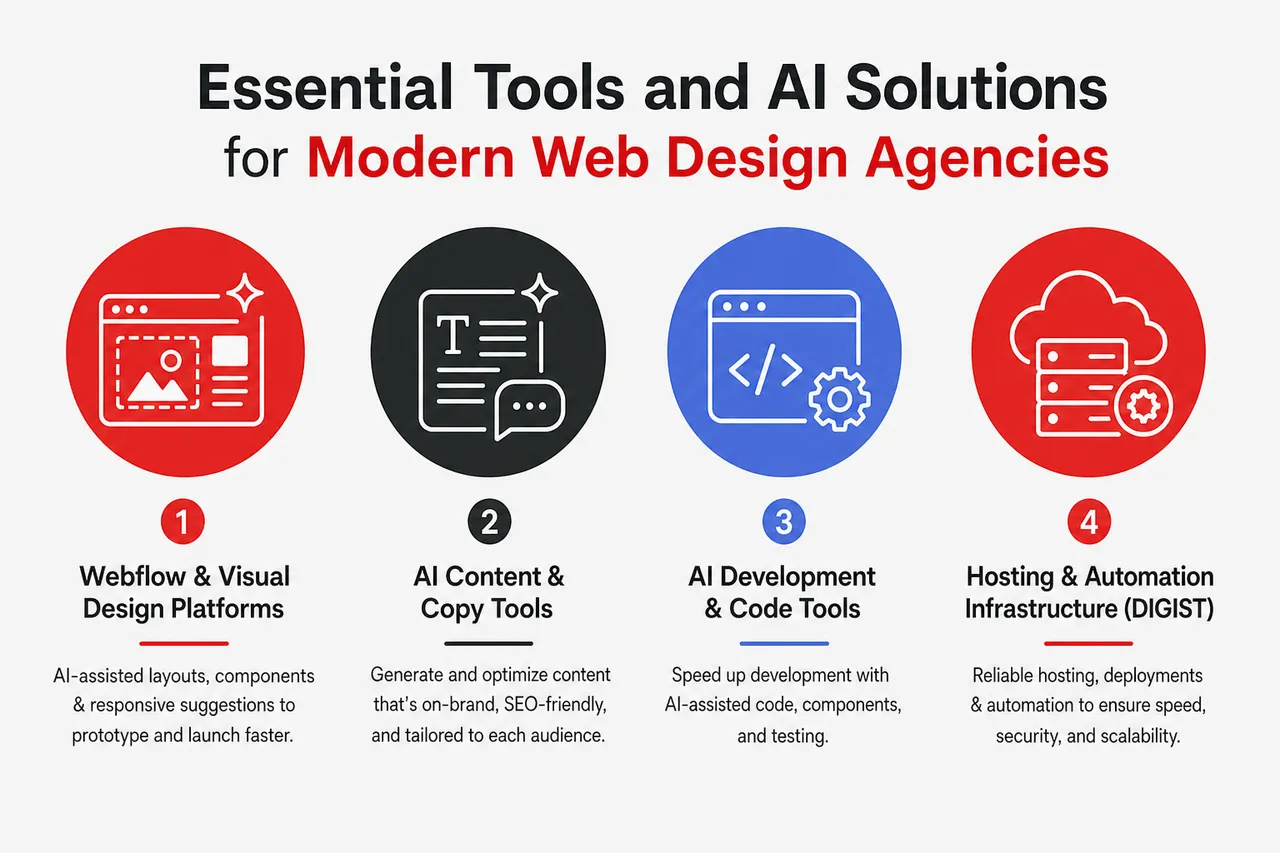
Efficiency and scalability depend on the right mix of technology, especially when clients are expecting faster turnaround times and more personalized experiences. The top agencies in 2026 combine modern design platforms, AI assisted content and development tools, and robust infrastructure such as DIGIST’s hosting and automation, so that every stage of the project lifecycle is supported, measured, and repeatable.
Top AI Web Design Tools and Platforms
Modern stacks are increasingly modular, which allows agencies to pair best in class tools with their own reusable components and processes. The aim is not to chase every new product, but to build a stable core that can be enhanced as AI capabilities improve.
- Webflow and similar visual builders: Visual builders with AI assisted layout and component suggestions allow designers to prototype, test, and iterate far faster than traditional hand coding. AI can suggest grid changes, color systems, and responsive adjustments, while your team focuses on UX, storytelling, and performance. When combined with a structured design system and DIGIST level automation for deployment, this greatly reduces time from concept to launch.
- GoHighLevel and agency CRMs: Platforms like GoHighLevel consolidate CRM, funnel building, email, and automation into a single environment. For web design agencies, this means you can connect sites to robust marketing sequences from day one, instead of handing off a static site. AI driven segmentation and lead scoring built into these tools help prioritize follow ups and nurture high value prospects, both for your clients and for your own agency pipeline.
- Generative AI for content, imagery, and code: Generative models now support everything from first draft copy and wireframe suggestions to hero imagery, icon sets, and boilerplate code. Agencies report that these tools can reduce initial production time by up to 50 to 60 percent when used responsibly. The key is to treat outputs as starting points: your team should refine messaging, enforce brand guidelines, and optimize assets for performance and accessibility before anything goes live.
When you connect these tools with structured project management platforms and DIGIST’s own automation and hosting, your team can deliver consistently high quality work faster and with less friction. This is particularly important as client expectations around speed, personalization, and measurable ROI continue to rise.
DIGIST: Custom Software and Marketing Solutions
DIGIST operates as a technology and marketing backbone for agencies that want to offer more than generic builds. By pairing tailored software with strategic marketing support, it helps agencies evolve from pure production shops into long term growth partners for their clients.
- Custom automation for agency workflows: DIGIST can automate critical internal workflows such as proposals, scope generation, client onboarding, asset collection, and reporting. When these steps are standardized and partially automated, agencies reduce errors, shorten project kickoff times, and create a more predictable experience for every client. One agency using DIGIST automation reduced manual project setup by around 70 percent, freeing senior staff to focus on strategy, upsells, and creative direction.
- Data driven marketing tools for your clients: Instead of treating marketing as an afterthought, DIGIST makes it simple for agencies to plug in analytics dashboards, campaign tracking, and AI powered optimization. This allows you to show clients how specific design changes and campaigns influence key metrics, such as conversion rate and cost per lead, and to iteratively improve their results. The result is a deeper, more durable partnership where you are trusted with ongoing growth rather than just redesign cycles.
- High performance hosting and technical reliability: In 2026, users expect sites to load quickly and respond instantly, and search engines increasingly reward performance and uptime. DIGIST’s high performance hosting helps ensure that your clients’ sites are consistently fast, secure, and stable, which is really important for both SEO and user experience. By bundling hosting with monitoring and proactive maintenance, your agency can offer premium care plans while DIGIST provides the underlying reliability.
Agencies that build on the DIGIST stack often find that their offers become more compelling because they can credibly promise better uptime, clearer reporting, and smarter automation. As Shadow Production shared, “A very good collaboration and unequalled patience. A team that is always ready to listen and provide the right solutions.”
Integrating AI Without Losing the Human Touch
AI can make your agency run smoother, but creativity and relationships keep clients coming back. In a world where AI can generate passable designs at the click of a button, your ability to listen, interpret nuance, and translate business models into digital experiences becomes your main differentiator.
- Preserve human contact at key touchpoints. While AI can manage reminders, basic support queries, and meeting scheduling, discovery calls, strategic workshops, and critical feedback discussions should remain human led. This is where you uncover subtle needs, internal politics, and opportunities that automated questionnaires often miss, and it is also where your team can demonstrate empathy and leadership.
- Use AI as a creative collaborator, not a director. Encourage designers, strategists, and developers to use AI to brainstorm variations, identify edge cases, and test flows, but maintain a process where people review, refine, and approve final outputs. Regular internal critique sessions, supported by DIGIST powered analytics, can help ensure that AI assisted work still aligns with brand, usability, and performance standards.
- Close the loop with continuous client feedback. Establish feedback channels through periodic check ins, post launch surveys, and shared dashboards. When clients see that their insights feed directly into your ongoing optimization work, they are more likely to view AI assisted automation as an extension of your service instead of a depersonalizing force. This feedback also helps you tune how much automation is appropriate for different client segments.
Agencies that mix AI efficiency with genuine human insight do not just deliver faster; they deliver more memorable, trustworthy experiences that clients are proud to put their brand behind.
Client Acquisition, Marketing, and Building Recurring Revenue Streams
Winning and keeping clients in 2026 takes more than a good portfolio. It demands smart positioning, AI powered marketing, and a business model engineered for lifetime value instead of one off projects. Agencies that master these areas can grow more predictably and reinvest profits into better talent, tools, and partnerships like those offered by DIGIST.
Digital Marketing Strategies for 2026
Most successful agencies now treat their own marketing like a client project, with clear funnels, consistent content, and continuous optimization. AI makes it possible to run more targeted, personalized campaigns without hiring a full scale in house marketing team.
- AI driven audience segmentation and messaging. Modern ad platforms and CRMs can cluster prospects by behavior, industry, and intent, then adapt ads and emails accordingly. For a web design agency, this means different messages for ecommerce founders, professional services, or healthcare providers, each tied to specific case studies and offers. DIGIST integrated analytics can help you quickly see which segments respond best and where to allocate budget.
- Personalized email and nurture sequences at scale. Generative AI can draft subject lines, email bodies, and follow up content that are tailored to different buyer stages. You can then layer in your agency’s tone, proof points, and service details. Over time, data on open rates, clicks, and meeting bookings allows your AI tools and DIGIST powered dashboards to refine these sequences into highly efficient, low effort lead nurturing engines.
- Thought leadership rooted in real client work. Publishing articles, teardown videos, and webinars about AI, conversion first design, and digital transformation helps attract decision makers who are actively searching for partners. When these assets reference anonymized results from DIGIST enabled projects, they become even more persuasive. This combination of education and proof often leads to inbound leads that are more qualified and less price sensitive.
For example, a DIGIST supported agency serving financial services firms used AI analytics to refine its content topics and targeting. Within six months, the firm increased inbound lead volume by about 55 percent, and average deal size rose as more prospects arrived already convinced of the need for a strategic partner rather than a basic redesign.
AI Enhanced Lead Generation and Sales Automation
AI tools can transform your sales process from reactive and manual to proactive and data driven. Instead of cold calling or waiting for contact form submissions, agencies can orchestrate multi touch journeys that surface the right prospects at the right time.
- Chatbots and interactive lead forms. AI chatbots embedded on your site can answer questions, pre qualify visitors, and route them to the right resource or calendar slot. Progressive profiling forms, backed by AI, gather information over multiple interactions instead of overwhelming prospects in a single step. This reduces friction while still giving your sales team enough context to have meaningful, timely conversations.
- CRM automation and deal tracking. Modern CRMs can automatically log interactions, score leads, and nudge reps to follow up based on engagement patterns. For a small agency, this means you can maintain enterprise level discipline without hiring a full sales operations team. When that CRM is integrated with DIGIST powered reporting, it becomes easier to tie sales activities directly to marketing initiatives and project outcomes.
- Predictive analytics for prioritization. AI based scoring models can combine firmographics, behavior, and historical data to predict which opportunities are most likely Finally and at what value. This allows founders and account managers to prioritize calls, proposals, and workshops that are more likely to pay off, instead of working through every lead in a linear fashion.
With these tools in place, agencies often experience shorter sales cycles, higher close rates, and better alignment between marketing and delivery. This efficiency frees time and budget to invest in better client experiences and deeper partnerships powered by platforms like DIGIST.
Creating Recurring Revenue Models
Project revenue is inherently uneven, which makes it difficult to plan hiring, investment, and owner compensation. Recurring revenue stabilizes your cash flow and encourages longer, more strategic relationships with clients, who benefit from continuous improvements rather than sporadic redesigns.
- Maintenance and optimization plans. Go beyond basic updates by offering monthly plans that include uptime monitoring, security patches, content changes, and periodic UX improvements. When you layer in AI powered performance and conversion monitoring, you can proactively recommend tweaks that improve results, justifying ongoing fees. DIGIST hosting and automation provide the technical foundation, while your team focuses on what to change and why.
- Hosting and performance bundles. By bundling high performance hosting, CDN, and performance audits into tiered packages, you can turn infrastructure into a profit center instead of a cost pass through. With growing attention on site speed and sustainability, clients are increasingly willing to pay for hosting setups that are demonstrably faster and more reliable than generic options.
- Strategic consulting and growth retainers. Many businesses lack in house digital strategy, so they welcome an ongoing relationship with a partner who can interpret analytics, propose campaigns, and roadmap new features. Monthly or quarterly strategy sessions, supported by DIGIST data and AI insights, position your agency as an external digital leadership team, which is harder to replace than a vendor that simply implements tasks.
DIGIST powered agencies have reported up to a 30 percent increase in annual revenue stability after introducing such recurring service models, along with higher client retention rates. Functional Fitness Rabat described this as working with “our strategic partner,” highlighting the trust that develops when support, hosting, and strategy are bundled into a single coherent relationship.
AI can help you find and onboard new clients, but brand, communication, and consistent results are what keep them. Recurring revenue models, supported by DIGIST’s infrastructure and analytics, give you the financial and operational stability to deliver that consistency year after year.
Scaling, Automation, and Future Proofing Your Web Design Business
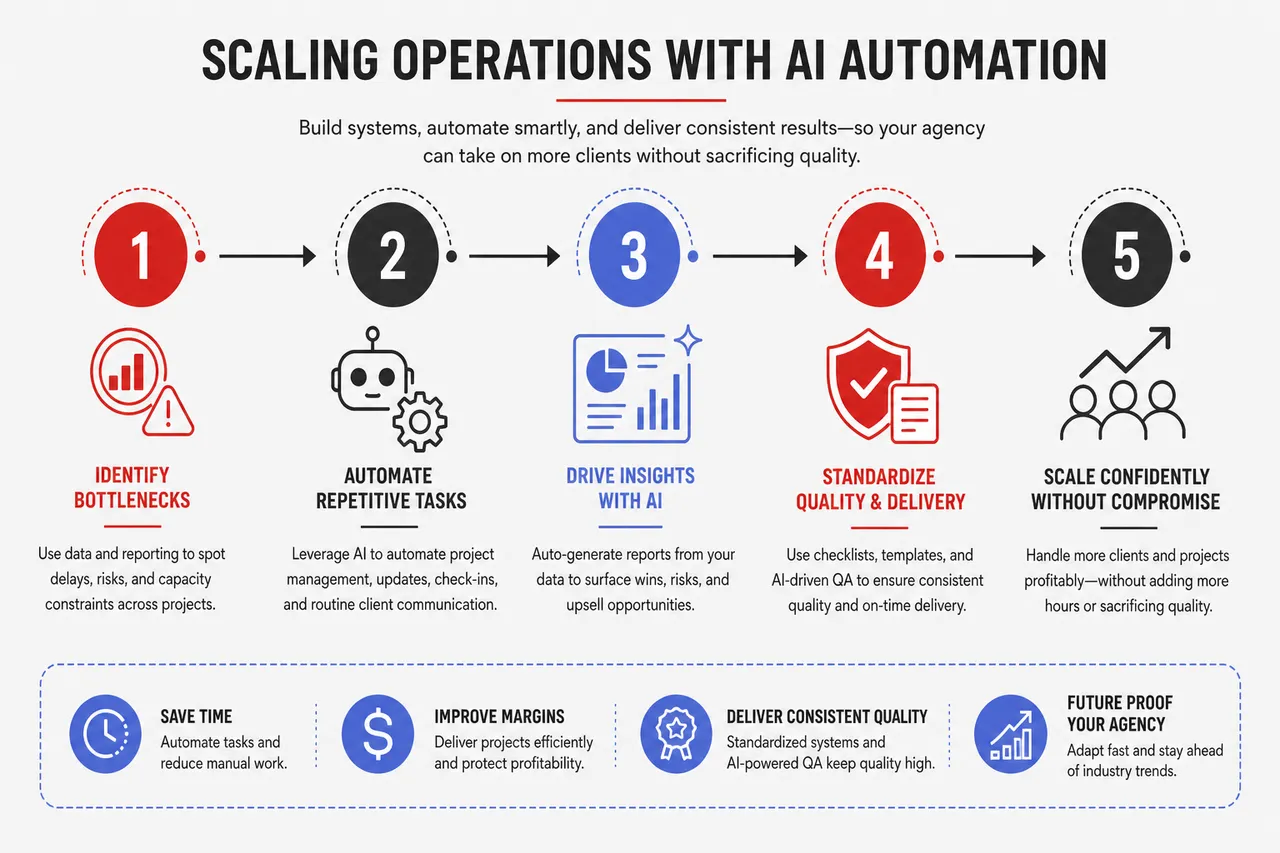
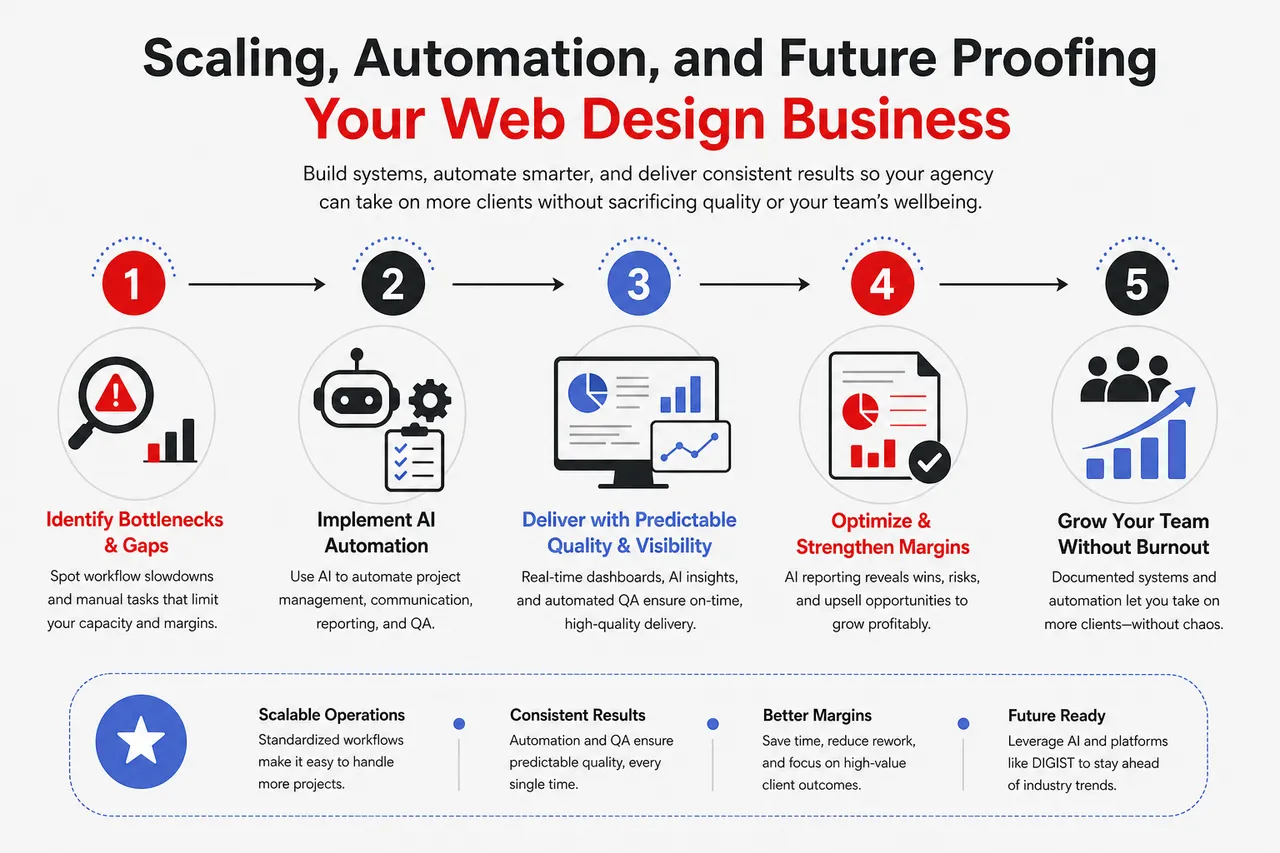
If you want your agency to grow and last, it is all about systems, smart automation, and staying ahead of industry trends. Agencies that organize their workflows and adapt quickly can take on more clients without sacrificing quality or burning out their teams. AI and platforms like DIGIST make it possible to scale intelligently instead of simply adding more hours.
Scaling Operations with AI Automation
Scaling is not just about selling more projects; it is about delivering them with predictable quality, timelines, and margins. AI driven automation can remove bottlenecks that usually appear when agencies grow beyond a handful of projects at once.
- Automated project management and communication. Project management tools now use AI to suggest timelines, allocate resources, and detect risks based on historical data. Automated status updates, reminders, and client check ins reduce the cognitive load on project managers and founders. When integrated with DIGIST’s reporting and automation, this creates a control center where you can see the health of all projects at a glance.
- AI driven reporting and insights. Instead of manually assembling reports each month, AI can pull data from analytics, heatmaps, CRM, and hosting logs, then summarize key changes, wins, and risks. Your team can then add commentary and recommendations. This turns reporting from a time consuming chore into a strategic touchpoint that reinforces your value and points to upsell opportunities.
- Automated quality assurance and compliance checks. Automated tools can continuously check sites for mobile responsiveness, accessibility errors, SEO fundamentals, and performance issues. As regulations and best practices evolve, these tools help you keep client sites compliant and competitive. DIGIST’s infrastructure can feed these checks with reliable performance and uptime data, making your QA process more robust.
Agencies that embrace this level of automation often report substantial time savings, fewer fire drills, and a noticeable boost in project delivery speed. This creates capacity for more ambitious projects and more strategic work per client.
Hiring, Outsourcing, and Building a Flexible Team
Staying agile means building a team that can flex with your workload while keeping core knowledge and client relationships in house. The combination of remote collaboration tools, AI assistance, and specialized partners has changed how agencies structure their teams.
- Define a strong strategic core. Keep a core group that owns client relationships, strategy, information architecture, and QA. This group ensures that every project reflects your agency’s standards and that DIGIST powered tools are used consistently. Even as you bring in contractors or partners, this core maintains continuity and protects your brand.
- Use specialists on demand. For tasks like motion design, advanced 3D, copywriting in specific industries, or complex integrations, it often makes sense to use trusted freelancers or specialized studios. AI tools like code assistants and content generators can support these experts, but the combination of domain expertise and human creativity is what makes high impact work. Building a vetted roster allows you to scale up quickly when a complex project lands.
- Outsource repeatable or technical tasks. Data migration, bulk content formatting, and initial CMS setups are critical but often repetitive. Delegating these to offshore partners or junior talent supported by AI checklists frees your senior team to focus on design, strategy, and client discussions. DIGIST automation can orchestrate handoffs and validations so that quality stays high even when work is distributed.
This hybrid approach lets you scale in response to demand while avoiding the overhead of a large permanent staff. It also makes your agency more resilient during market fluctuations, since you can dial capacity up or down without sacrificing client service.
Adapting to Industry Trends and Overcoming Challenges
The web design landscape is evolving quickly, driven by AI advances, changing user expectations, and regulatory shifts around privacy and accessibility. Agencies that treat learning and adaptation as ongoing disciplines are more likely to thrive than those that stick rigidly to past playbooks.
- Continual learning about AI and UX best practices. Set aside time for your team to explore new AI capabilities, design trends, and UX research. Internal demos, lunch and learns, and experimentation sprints can help you distinguish lasting shifts from short lived hype, and DIGIST often serves as a practical sandbox for testing how new tools fit into real workflows.
- Monitoring privacy, security, and accessibility requirements. Regulations and expectations around data, consent, and inclusive design are tightening, especially in sectors like healthcare, finance, and education. Staying ahead of standards like WCAG and emerging AI governance frameworks not only protects your clients but can also become part of your value proposition. DIGIST’s emphasis on secure hosting and robust logging helps you implement and document compliance measures.
- Refreshing service offerings in line with market needs. As AI powered personalization, performance first design, and sustainability move from differentiators to expectations, agencies need to update packages, case studies, and pricing to reflect new value drivers. Regularly reviewing which services are most profitable and most requested, using DIGIST analytics and your own financial data, ensures that your catalog remains relevant and competitive.
In 2026, growth is less about adding more people and more about building systems that amplify your team’s strengths. Smart automation, flexible staffing, and disciplined adaptation position your agency to handle both steady demand and sudden spikes without losing quality or burning out your team.
From Design Vendor to AI Era Growth Partner
As AI reshapes how websites are built, discovered, and experienced, the most resilient agencies are those that reposition themselves from design vendors to holistic growth partners. This means going beyond layout and code to understand how clients acquire customers, deliver value, and scale, then using tools like DIGIST to support that entire journey.
Aligning Web Design With Revenue and Operations
Instead of treating web projects as isolated initiatives, tie them directly to your clients’ revenue goals, sales processes, and operational constraints. Map how leads flow from landing pages into CRMs, how content supports sales conversations, and how automation reduces manual work. When DIGIST underpins this ecosystem with integrated hosting, analytics, and marketing automation, your agency can demonstrate how each design decision supports measurable business outcomes, which strengthens trust and justifies larger, longer term engagements.
Embedding Measurement and Experimentation Into Every Build
AI powered sites are rarely finished; they are continuously optimized based on user behavior and market shifts. Make experimentation part of your standard offer by including analytics, event tracking, and A/B testing setups in every project. Use DIGIST dashboards to surface insights in language that non technical stakeholders can understand, and propose regular optimization cycles. This experimentation mindset not only improves results over time but also reinforces your role as an ongoing strategic partner rather than a one time implementer.
Positioning DIGIST as Your Strategic Advantage
In a crowded agency landscape, your underlying platform can be as much a differentiator as your creative style. By building your services around DIGIST’s tailored software development, high performance hosting, and data driven marketing tools, you can credibly promise better reliability, clearer reporting, and more leverage from AI than competitors relying solely on generic tools. Make this platform story explicit in your pitches and marketing, explaining how DIGIST enables you to deliver faster, more secure, and more insightful projects without compromising on human touch or strategic depth.
Building a profitable web design business in the age of AI is about more than tools and templates; it is a blend of strategic planning, the right technology, and a commitment to delivering real value. Agencies that seamlessly combine AI powered solutions with genuine human insight set themselves apart, winning client trust and achieving steady growth. With DIGIST’s tailored solutions and a focus on innovation, you are well equipped to lead the charge in 2026. Start now, embrace the changes, and build a web design agency that does not just survive in the AI era but truly thrives.